

The framing “Which companies have AI exposure?” is too broad to be useful. Every software company now claims AI exposure. Every chip company has an AI story. Every utility, REIT, industrial supplier, and cable manufacturer can find a way to mention data centers on an earnings call.
The better question is narrower:
Where is AI demand hitting a physical constraint that supply cannot quickly solve?
That is where the real trade lives. In the bottlenecks.
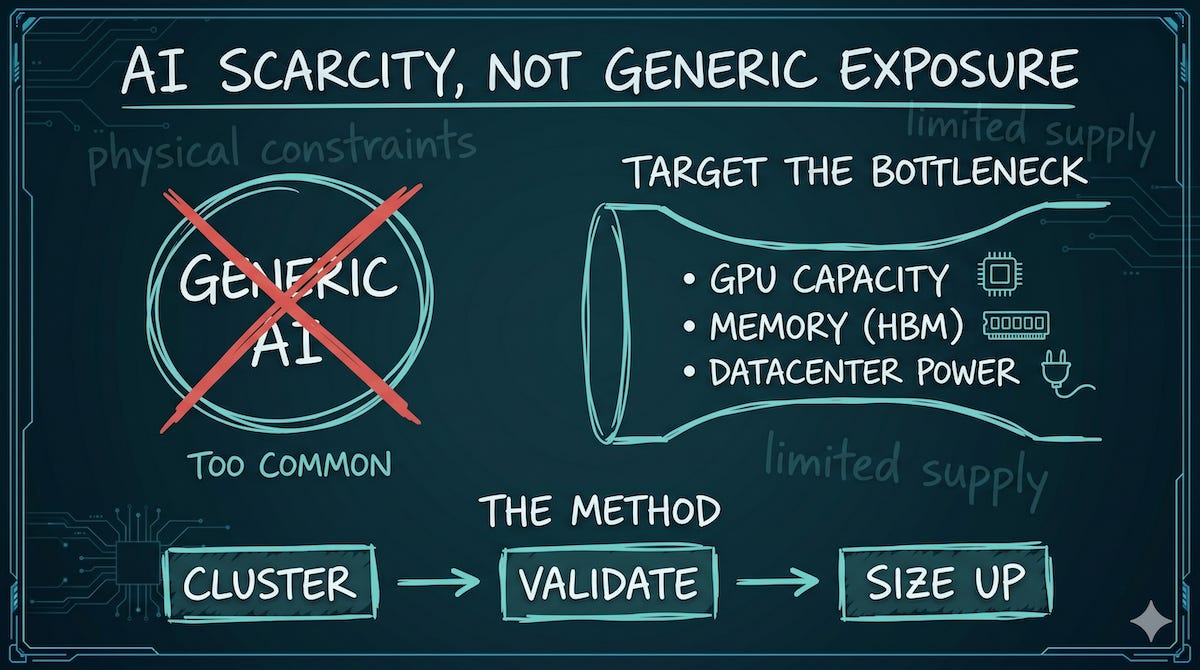
The AI ecosystem is no longer defined by algorithms alone. It is increasingly defined by bottlenecks.
AI demand does not spread evenly across the technology stack. It concentrates. First it concentrated into GPUs. Then memory bandwidth. Then advanced packaging. Then networking. Then optical interconnects. Then power delivery. Then cooling. Then grid interconnection. Eventually it reaches transformers, generation capacity, critical materials, and even land with access to power.
The most important developments in AI often emerge not from what is abundant, but from what is scarce.
A bottleneck is not simply “a thing AI uses”. That definition is too loose. A real bottleneck has specific characteristics:
Demand is growing faster than supply
Capacity takes years to expand (as opposed to weeks or months)
There are few viable alternatives
The layer is unavoidable for system performance
Existing solutions begin to show limits
Customers become willing to pay a premium for relief
New technologies emerge specifically to address the constraint
This is why thinking in terms of “AI exposure” misses the point.
Many technologies can find a way to “participate” in AI, but that’s not the point. The critical question is whether frontier AI systems can continue scaling without them.
If GPUs cannot access memory fast enough, memory bandwidth becomes the bottleneck.
If memory cannot be integrated efficiently with accelerators, advanced packaging becomes the bottleneck.
If clusters cannot move data quickly enough, networking becomes the bottleneck.
If electrical interconnects become too power-hungry or inefficient, optics becomes the bottleneck.
If racks become too dense, cooling becomes the bottleneck.
If data centers cannot secure enough power, the bottleneck shifts to transformers, substations, transmission infrastructure, and generation capacity.
The constraint keeps moving.
This is why next set of breakout AI startups might not be foundation model companies. They will be the ones building solutions to these bottlenecks.
Some are developing new memory architectures. Others are working on photonics, optical networking, advanced cooling systems, power management, chiplet interconnects, packaging technologies, or software that improves hardware utilization. Entire categories of startups exist because a specific layer of the stack has become constrained.
Historically, major technology waves create new bottlenecks as they scale. The internet created networking bottlenecks. Mobile computing created battery and semiconductor bottlenecks. Cloud computing created data center bottlenecks.
AI is doing the same thing, but at a much larger scale. The key insight is that bottlenecks are dynamic. Solving one often reveals another.
A breakthrough in packaging may shift pressure to memory. A breakthrough in memory may shift pressure to networking. Better networking may expose limitations in power delivery. More power may create new cooling challenges.
As a result, the most valuable technologies are often those that remove a constraint from the system.
Sometimes those technologies come from established suppliers. Sometimes they come from startups that are still largely unknown. In both cases, the underlying logic is the same: value accrues to the layer that enables the next stage of scaling.
This perspective also changes how we think about technological progress. Instead of asking which AI model is best, ask what prevents the next generation of models from existing. Instead of asking which company mentions AI most often, ask which layer of the stack is becoming unavoidable.
By the time everyone agrees a bottleneck is critical, much of the opportunity has already been recognized. The challenge is identifying the next constraint before it becomes obvious.
If you are getting value from this newsletter, consider subscribing for free and sharing it with 1 infra-curious friend: